
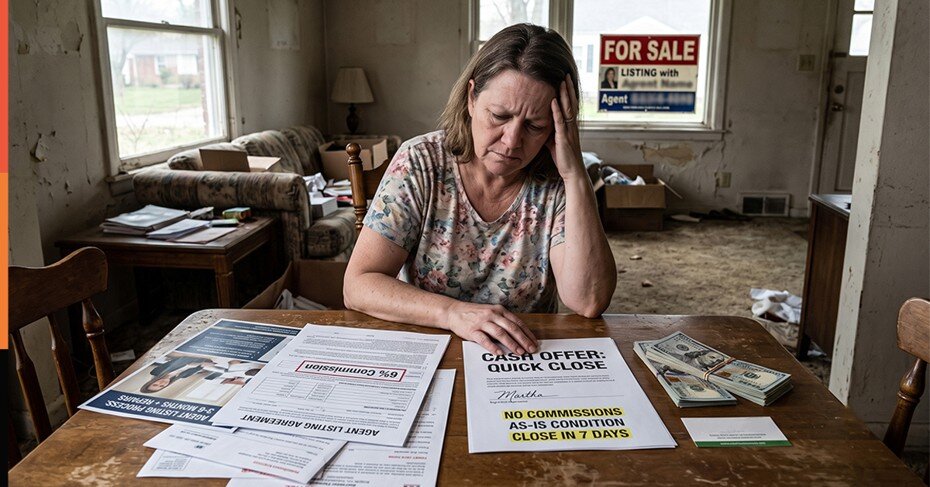
Selling distressed property through a cash sale is often faster and easier than listing with an agent. Cash buyers buy homes as-is, skip repairs, and usually close in one to two weeks instead of months.
More and more home buying companies now help people who need to sell fast without fixing anything first. These companies work with people going through hard times, like missed payments, an inherited home, a rental they’re tired of, or storm and fire damage. They buy homes directly, pay cash, and let the seller pick the closing date.
Why Do Distressed Homeowners Often Feel Stuck?
Owning a distressed property can feel like carrying a weight you didn’t ask for. The house sits there, the bills keep coming, and the to-do list never seems to shrink. For some owners, the issue is money. Repairs pile up faster than savings can cover them, and a leaky roof or cracked foundation can turn into a much bigger bill if it waits too long. For others, the issue is time. A new job, a sick relative, or a sudden move doesn’t leave room for months of showings and repair work.
There’s also an emotional side many people don’t talk about. Inherited homes carry memories, and walking through a parent’s old house while deciding what to fix or sell can feel heavy. Knowing your options ahead of time makes that process a little less overwhelming.
What Does Selling Distressed Property Actually Mean?
A distressed property is a home with money, repair, or life-situation problems that make a normal sale harder. Knowing which type fits your home helps you pick the right path forward.
Money problems include missed mortgage payments or a foreclosure date coming up fast. Repair problems mean the home needs work the owner can’t pay for. Life-situation problems include an inherited home, an empty rental, or a sudden move. Most people selling distressed property fall into at least one of these three groups, and some fall into all three at once.
Cash Sale vs. Traditional Listing: A Side-by-Side Comparison
Choosing between a cash sale and a regular listing comes down to a few simple factors. This table lays out the differences clearly.
| Factor | Cash Sale | Traditional Listing |
| Repairs needed | None | Usually yes |
| Average closing time | 7 to 14 days | 30 to 90 days |
| Agent commissions | None | 5 to 6 percent |
| Risk of buyer’s loan falling through | None | Common |
| Inspection back-and-forth | None | Common |
This table shows why speed and certainty often matter more than a higher but uncertain price. A listing might bring in more on paper, but that number can shrink fast once commissions, repairs, and months of holding costs come out of it.
How Cash Buyers Determine Their Offer?
A common question homeowners ask is how a cash buyer comes up with a number without an open-market bidding process. The answer is more straightforward than it sounds.
Buyers typically look at recent sale prices of similar homes nearby, then factor in the home’s current condition. They estimate what repairs would cost if they had to bring the home up to market standard, and they subtract that from the home’s likely resale value. What’s left becomes the offer, along with a margin that accounts for closing costs and the time it takes to resell.
This is why two homes on the same street can get very different offers. A home with a new roof and working plumbing will naturally get a higher number than one with major structural damage.
When Selling Distressed Property as a Cash Sale Makes the Most Sense?
A cash sale isn’t right for everyone, but a few situations make it the clear better choice. Spotting these signs early can save you months of stress.
It often makes sense when repairs cost more than you can pay upfront. It also fits when speed matters more than getting top dollar, like when foreclosure is close or you need to move fast. People who inherited a home and don’t want to deal with repairs or showings often pick this route too. For example, someone in Clearwater who wants to sell a damaged house fast in Clearwater, FL after storm damage may solve both problems at once with a cash sale.
What Happens to Liens, Back Taxes, or a Second Mortgage?
Many distressed homes come with more than just repair needs. Unpaid taxes, contractor liens, or a second mortgage can sit on the title and complicate a sale.
The good news is that these debts don’t have to stop you from selling. Most cash buyers handle title work as part of the closing process, which means liens and back taxes typically get paid off from the sale proceeds. A title company confirms exactly what’s owed before closing, so there are no surprises at the table.
This is one area where a cash sale can save real time. Traditional buyers and their lenders often hesitate when they see an unresolved lien, since it can delay or even cancel financing. Cash buyers don’t have that same restriction.
Steps to Selling Distressed Property for Cash
The process is simpler than most people expect. Here’s how it usually works.
- Ask for an offer – Share a few basic details about the home’s condition and location.
- Get a cash offer – Most buyers respond within 24 to 48 hours, often with no strings attached.
- Look over the terms – Compare the offer to what you might net from a regular sale.
- Pick a closing date – You choose a timeline that works for you, from one week to a few months out.
- Close and get paid – You’ll usually get your money by wire or cashier’s check, with no repairs needed first.
FAQs
Q1) Is a cash offer always lower than a listing price?
Often a bit lower, but once you subtract commissions, repairs, and holding costs, the final number can be close.
Q1) How fast does a cash sale usually close?
Most cash sales close in 7 to 14 days, compared to 30 to 90 days for a home listed with an agent.
Q2) Do you need good credit to sell a house for cash?
No. Cash buyers look at the home itself, so your personal credit history doesn’t affect the sale at all.
Q3) Can a distressed property with code violations still sell for cash?
Yes. Cash buyers usually purchase homes with code violations, liens, or structural damage without asking for any repairs first.
Q4) Are there fees when selling a distressed property for cash?
Usually none. Most cash sales skip the agent commissions and closing costs that come with a regular listing.
Q5) What kinds of damage do cash buyers accept?
Cash buyers commonly accept fire damage, water damage, foundation problems, mold, and homes left empty or half fixed up.
Ready to Sell Your Distressed Property Without the Hassle?
If repairs, time, or uncertainty are holding up your sale, a cash offer can clear that path fast. Tampa Fast Home Buyer works with homeowners facing distressed properties, giving fair cash offers with no repairs and no waiting on a bank. Reach out today to see what a no-obligation offer looks like for your home.